Our Pillars.
A technical framework for ecological and human permanence.
Operational Autonomy & Self-Sustaining Life
The first step will be to establish our ‘Mother House,’ an engineering core designed to ensure that every human footprint is a benefit to the forest. This is the infrastructure plan that we will install to secure energy, water, and shelter, creating the living model that will protect the sanctuary from day one.
- The first step is a detailed assessment of the land: soil composition, water flow, topography, vegetation, and degraded areas.
- Based on this analysis, the territory is zoned to define:
- restoration areas,
- food production zones,
- animal management areas,
- and the location of core infrastructure.
- This ensures that every intervention responds to the land’s real conditions, not abstract plans.
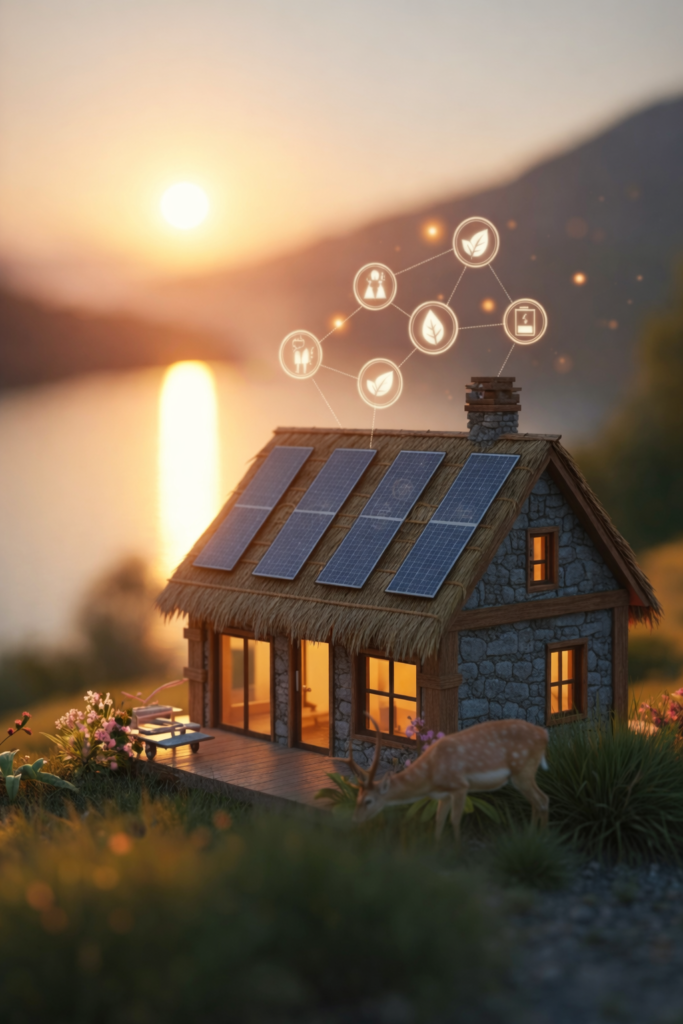
- The Mother House is the operational heart of K’aax Chejé and the first fully integrated living system. It serves as the blueprint that will later be replicated across future cabins and modules.
- Its construction combines ancestral Mayan building principles with modern sustainable techniques, using stabilized compressed earth blocks (CEB), local materials, and lime-based methods to minimize embodied carbon and environmental impact.
- From the outset, the Mother House is designed to be functional, durable, and visually intentional, proving that self-sustaining architecture can be beautiful, comfortable, and refined without increasing ecological pressure.
- Passive design strategies, thermal mass, cross-ventilation, and natural airflow, ensure long-term comfort while reducing the need for artificial climate control.
- Materials are selected for performance, low toxicity, and reversibility, allowing structures to age naturally and return to the land with minimal trace.
- Energy autonomy is achieved through a robust, well-planned solar system, designed around ultra-low consumption and long-term reliability rather than excess generation.
- Architectural efficiency and passive design significantly reduce energy demand before production is considered, ensuring a balanced and resilient system.
- Energy infrastructure is planned with a full life-cycle perspective, prioritizing durability, modular upgrades, repairability, and responsible end-of-life management.
- By treating energy as a closed-loop system rather than a disposable resource, K’aax Chejé demonstrates that off-grid living can remain reliable and environmentally accountable over decades.
- Rainwater harvesting systems will supply the primary water needs of the Mother House and surrounding infrastructure.
- Water is filtered, treated, and reused on-site, closing the loop through:
- biodigestors,
- constructed wetlands,
- and natural phyto-purification systems.
- Treated water returns safely to the land, supporting irrigation and ecosystem hydration while protecting the aquifer.
- Pillar 1 establishes the first self-sustaining food systems, designed to supply daily needs while restoring soil health.
- Practices include:
- regenerative agriculture,
- crop rotation,
- polycultures,
- hydroponic and low-water systems,
- and the complete avoidance of synthetic fertilizers and pesticides.
- The objective is to produce more with less, demonstrating that food security and ecological balance can coexist.
- Carefully managed farm animals are introduced as part of a closed-loop system, contributing to soil fertility, landscape management, and food autonomy.
- Manure and organic waste are processed through composting and biodigestors, transforming waste into nutrients and energy.
- These systems are designed for balance, not scale, serving as a model for future replication.
- Beekeeping and native pollinator support are integrated early to strengthen ecosystem resilience and food production.
- The first wetlands, shaded corridors, and reforested patches are created to begin attracting birds, insects, amphibians, and small wildlife.
- Biodiversity is encouraged from the start, even before formal conservation phases begin.
- Pillar 1 is the testing ground where systems are refined, measured, and adapted.
- Once proven reliable, these systems become the blueprint that will be replicated across cabins, visitor zones, and future expansion areas.
- This ensures that growth is not experimental, but based on what already works.
Low-Impact Ecotourism (Education Through Presence)ional Autonomy & Self-Sustaining Life
This pillar represents the expansion phase of K’aax Chejé. It builds directly on the proven systems established in Pillar 1 and focuses on creating the conditions that allow the project to grow responsibly, ecologically, socially, and economically. The objective is to create a place where people can experience sustainable living in practice, while generating the stability required for long-term restoration and conservation.
- Once the Mother House systems are fully installed and operating, the same off-grid model will be replicated and adapted across additional structures.
- Each cabin or visitor unit will function as an independent, low-impact module, with its own water capture, energy autonomy, and waste-to-resource systems.
- This modular approach allows the project to grow without increasing environmental pressure, ensuring that expansion never compromises ecological balance.
- This phase includes active reforestation, soil recovery, and landscape remodeling designed to restore natural processes and attract native species naturally.
- As vegetation, water systems, and habitat complexity increase, the land itself becomes the primary attraction — supporting birds, amphibians, reptiles, and small mammals without forced intervention.
- Visitors will witness regeneration as an ongoing process, not a finished product.
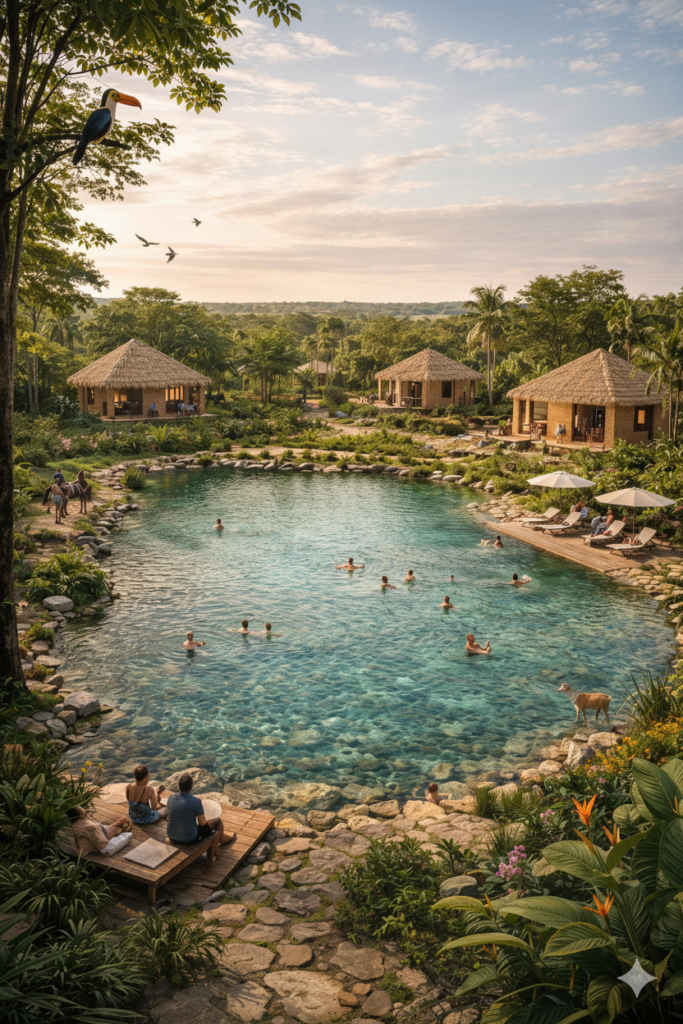
- A large natural bio-pool will be developed as a central living system, designed to integrate recreation, ecology, and education.
- This water body will function simultaneously as:
- a natural swimming area,
- a regenerative aquatic ecosystem,
- and a controlled environment that mirrors local rivers and wetlands.
- Beyond recreation, it will support biodiversity, environmental learning, and future restoration initiatives, demonstrating how water infrastructure can enhance life rather than replace it.
- Human activities during this phase will remain non-invasive and land-based, focusing on connection rather than exploitation.
- These may include walking trails, bird observation, cycling routes, kayaking through the canal system, and guided nature experiences.
- All activities are designed to operate within strict ecological limits, prioritizing respect, learning, and coexistence.
- The sanctuary will offer limited lodging options, including low-impact cabins and designated camping or glamping areas, allowing visitors to experience life in the landscape without altering it.
- These spaces are designed to be reversible and adaptable, ensuring the land retains its integrity over time.
- Seasonal use allows the ecosystem to rest and recover, preventing continuous pressure on the environment.
- K’aax Chejé will welcome schools, educational centers, and universities as part of its educational mission.
- The site functions as a living laboratory, where sustainable agriculture, water management, renewable energy, and land regeneration can be observed and studied in real conditions.
- As systems mature, courses and workshops may be offered to share knowledge and demonstrate how regenerative practices can be implemented elsewhere.
- During this phase, the sanctuary begins laying the operational and ecological foundations required for future wildlife rescue, management, and restoration.
- Infrastructure, protocols, and professional collaboration are developed gradually, ensuring that animal welfare and habitat integrity are never compromised by premature expansion.
- This measured approach allows wildlife restoration to grow in parallel with the project’s capacity to sustain it.
- Revenue generated through low-impact stays, educational activities, and on-site experiences is reinvested directly into:
- land regeneration,
- infrastructure improvement,
- community involvement,
- and preparation for future conservation phases.
- The project is designed to reduce dependency on donations over time, creating a balanced system where economic activity supports ecological restoration rather than replacing it.
Wildlife Restoration.
(Habitat, Protection & Reintroduction)**
This pillar represents the long-term vision of K’aax Chejé. It becomes fully active once the project has achieved operational stability, financial resilience, and proven land-management capacity through the first two pillars. Wildlife restoration is approached as a progressive, responsible process, growing only at the pace the land and the project can sustain.
- As resources and capacity grow, additional hectares will be acquired and permanently designated for conservation and habitat protection.
- These lands will be restored and managed as safe, uninterrupted ecosystems, protected from deforestation, fragmentation, and illegal hunting.
- By securing land ownership and long-term protection, the sanctuary ensures that restored habitats remain safe for wildlife across generations.
- Restoration begins with soil regeneration, reforestation, hydrological recovery, and landscape restructuring.
- Native plant species and ecological complexity are reintroduced to recreate the conditions required for wildlife to return naturally.
- The objective is not to force biodiversity, but to allow ecosystems to rebuild themselves.
- With stable income and operational maturity, the project will expand its UMA (Wildlife Management Unit) activities under professional supervision.
- This includes rescue, rehabilitation, managed reproduction, and preparation for release, always within ethical and ecological limits.
- Capacity increases only when animal welfare, habitat quality, and long-term sustainability can be guaranteed.
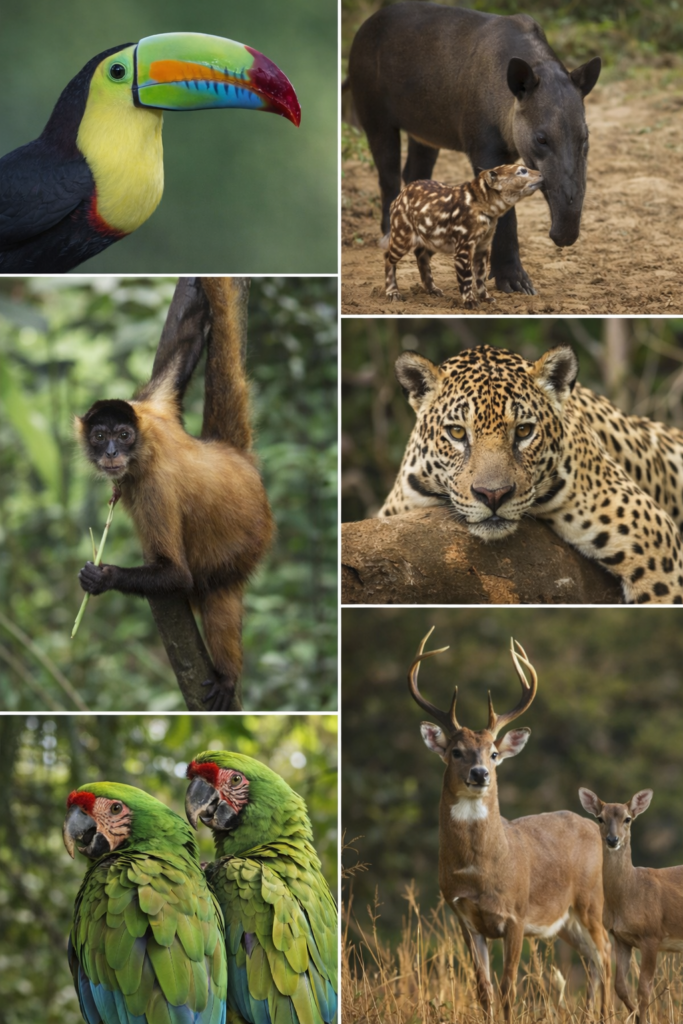
- K’aax Chejé will prioritize species native to Campeche and the surrounding ecosystems, particularly those affected by habitat loss, fragmentation, and illegal trade. This may include, among others:
- Birds: toucans, parrots, green macaws, wild turkeys, pheasants, regional songbirds, and aquatic birds.
- Mammals: white-tailed deer, brocket deer, peccaries, coatis, raccoons, jaguarundis, ocelots (tigrillos), and other small to mid-sized mammals.
- Primates: native monkey species where ecologically appropriate.
- Reptiles & Amphibians: native turtles, reptiles, amphibians, and keystone aquatic species.
- In the medium to long term, the project aspires to support the restoration and reintroduction of keystone species, such as the Baird’s tapir, whose ecological role is critical for seed dispersal and forest regeneration.
- By restoring habitats and maintaining zero tolerance for poaching, the sanctuary becomes a safe haven not only for introduced species, but also for wildlife arriving naturally from surrounding areas.
- Many species are expected to recolonize the land on their own once conditions are favorable and human pressure is removed.
- This natural return of wildlife is considered one of the most important indicators of ecological success.
- The sanctuary will collaborate with authorized institutions, biologists, veterinarians, and conservation organizations to receive animals affected by injury, displacement, or illegal trafficking.
- Whenever possible, the goal will be rehabilitation and release into protected habitats.
- Animals that cannot be released will be cared for under conditions that prioritize dignity, space, and minimal human interference.
- As biodiversity increases, K’aax Chejé becomes a valuable site for:
- species observation,
- birdwatching and wildlife photography,
- ecological research,
- and long-term monitoring.
- The sanctuary will welcome collaboration with universities, researchers, conservation NGOs, and international volunteers aligned with its ethical framework.
- These collaborations strengthen conservation outcomes while helping sustain the project economically and scientifically.
- Once the system is fully operational, the project aims to collaborate with other sanctuaries, conservation programs, and NGOs to share knowledge, strategies, and best practices.
- The long-term goal is not isolated success, but regional impact, contributing to broader conservation efforts beyond the sanctuary’s boundaries.